

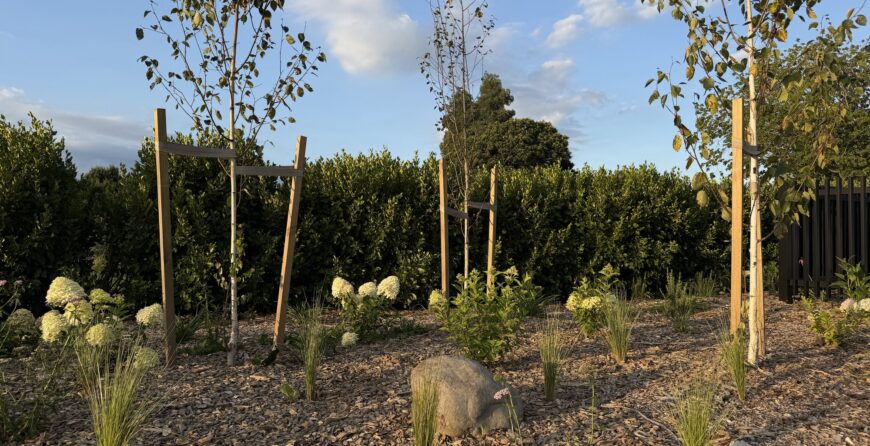
The most common planting mistake I see is starting with a wishlist. Someone falls for a plant at the garden centre, takes it home, puts it in, and a year later it is struggling, or it has swallowed the path, or it has died. The plant was rarely the problem. It was in the wrong place. Good planting works the other way around. You start with the site, then choose plants that already want to grow there. Get that right and the garden half looks after itself.
Start with your conditions
New Zealand does not have one climate, it has dozens. A coastal Northland garden and a frosty inland one have almost nothing in common, and even within a single property the conditions shift from the hot dry strip against a north wall to the damp shade down the side. So before any plant names, I look at what the site actually gives me. How much sun each area gets, how exposed it is to wind, whether the soil drains freely or holds water, how hard the frosts get, and whether salt wind is in play. Those few things rule most plants in or out before you have even opened a plant book. “Right plant, right place” sounds obvious, but it is the single thing that decides whether a garden thrives or limps along.
Think in layers, not lists
A good planting plan is not a shopping list, it is a structure. I think of it in layers. First the bones, the evergreen structure that holds the garden together all year, whether clipped or loose. Buxus (Buxus sempervirens) and griselinia (Griselinia littoralis) are the usual go-tos, or corokia for a hardy native option. Then the feature plants that give a garden its character. A nikau (Rhopalostylis sapida) or a tree fern (Cyathea or Dicksonia) for a lush, sub-tropical feel, or a white-barked Himalayan birch (Betula utilis var. jacquemontii) for something lighter and more open. Then the mid layer and the groundcovers that knit it all together and keep the weeds down, from tractor seat ligularia (Ligularia reniformis) in the damp, shady spots to tough, strappy lomandra in the sun. When those layers work as a whole, the garden reads as designed rather than collected, and it still looks good in winter, not just at the peak of summer.
Natives and exotics both earn their place
There is no need to be purist about it. Natives are tough, they suit our conditions and they bring birds in, and plants like flax (Phormium), astelia, libertia and the native sedges (Carex) do a lot of work for very little fuss. But exotics earn their place too. A hydrangea like ‘Limelight’ (Hydrangea paniculata) flowering through late summer, a clipped olive, a drift of gaura for movement, or sedum (Sedum ‘Autumn Joy’) for late-season colour can lift a planting in a way a purely native scheme sometimes cannot. The best gardens usually use both, chosen for the job rather than the label.
Plan for the plant it becomes
The mistake that is hardest to undo is planting for today instead of for five years’ time. That neat little shrub in a small pot might be three metres across when it grows up. So I plant to the mature size, space accordingly, and accept that a new garden looks a touch sparse at first. It fills in. Crowding everything together for an instant result just means digging half of it out later. Be honest with yourself about maintenance too. If you do not want to be clipping and pruning every weekend, choose plants that look good doing their own thing.
Where a plan takes the guesswork out
This is the part that is genuinely hard, and it is where having someone do it for you pays off. Reading a site, matching plants to it, and combining them so they work in layers and across the seasons is a skill, not a guess. If you would rather not gamble on it, a planting plan takes the risk out. The right plants, in the right places, in the right numbers, mapped out so you or your installer can simply plant it.
If you would like a planting plan drawn up for your place, that is exactly what I do.
Thinking about your own garden?
Every project starts with a free, no-obligation proposal. Tell me about your site and what you are after, and I will show you how I would approach it.